.svg)


These are words that appear frequently in British education. They feature in school prospectuses, co-curricular programmes and conversations about how best to prepare young people for life beyond the classroom.
And they are all hugely important.
But there is a more fundamental question worth asking:
Resilience cannot simply be taught. It develops when things don't go to plan. Leadership is difficult to learn without genuine responsibility. Independence requires young people to step beyond the structures they are familiar with. And empathy grows when they encounter people whose lives and experiences are different from their own.
This is where an idea with a long tradition in American education becomes particularly interesting: service.
Across many American schools and universities, particularly independent schools and colleges, there is a strong tradition of encouraging students to contribute to something beyond themselves.
Increasingly, this is described as service-learning.
The important distinction is that service-learning isn't simply about completing a certain number of volunteering hours. The experience itself becomes part of the education.
At its best, service isn't about arriving somewhere with the assumption that there are people who need to be "helped". Instead, it is about working alongside others, understanding a different community or environment, contributing something genuinely useful and recognising that there is just as much to learn as there is to give.
A young person may give their time, energy and enthusiasm, but what comes back can be equally valuable: perspective, confidence, understanding and, sometimes, the realisation that they don't have all the answers.
That feels increasingly relevant in education today.
British schools already provide an extraordinary amount of learning beyond the classroom.
Sport, music, drama, outdoor education, the Duke of Edinburgh's Award, CCF, volunteering, expeditions and countless clubs and societies form an important part of school life.
We tend to gather all of this under the banner of the co-curriculum.
And when explaining why the co-curriculum matters, schools often return to the same qualities:
Resilience. Teamwork. Communication. Leadership. Problem-solving. Adaptability.
But perhaps these words have become so familiar that we sometimes lose sight of what they actually mean.
A young person doesn't become resilient because resilience appears in a school prospectus.
They become resilient when they're tired, something has gone wrong and the rest of the team still needs them.
Leadership becomes real when somebody else is relying on them.
Communication takes on a different meaning when they're trying to understand someone whose background or experience is completely different from their own.
Adaptability matters when Plan A has disappeared.
And confidence grows from that wonderful moment when a young person thinks:
"I wasn't sure I could do that, but I did."
Perhaps, then, we should talk a little less about character building and a little more about character in action.
Because character isn't something we can simply give young people.
We need to give them opportunities to discover and develop it for themselves.
Having worked within a British school environment, Miranda has seen first-hand how much schools already do to develop young people beyond their academic education.
But there is something particularly powerful about taking young people outside their familiar environment.
Travel, expeditions and thoughtfully designed service programmes can do exactly that.
Suddenly, young people are navigating different cultures, unfamiliar surroundings and experiences they may never otherwise encounter.
They have to contribute to a team, cope when things change, solve practical problems and take responsibility for themselves and for each other.
Service adds another dimension because it shifts the emphasis away from the individual.
The question stops being simply:
"What will I get out of this?"
and becomes:
"What can I contribute?"
That distinction matters.
So much of a young person's education is understandably focused on their own achievement - their grades, university choices, CV and future career.
Service creates an opportunity to look outwards and recognise that education can also be about what we contribute to the world around us.
This became particularly real to Miranda while leading an Under 18 Leap trip to Kenya.
Over the course of the experience, she watched young people navigate being tired, being away from home, working as part of a group and finding themselves in situations they couldn't necessarily predict or control.
Nobody needed to give them a lesson entitled "Resilience".
They were practising it.
The same was true of teamwork, independence, communication and leadership.
Some of the most valuable moments weren't necessarily the big, planned activities. They were the smaller moments: when somebody stepped forward to help another member of the group, adapted when something changed, took responsibility or simply realised they were capable of more than they had thought.
That is character in action.
And perhaps this is where the American tradition of service and the British co-curricular tradition have more in common than might initially appear.
Perhaps service isn't something missing from British education at all.
Much of it is already happening through the co-curriculum.
But the American tradition of service-learning offers a useful way of joining the dots, connecting practical experience and contribution with the qualities schools are already trying to develop in young people.
As schools consider how best to prepare students for a rapidly changing world, perhaps the question shouldn't only be:
"What do we want young people to learn?"
It should also be:
"Where are we giving them the opportunity to put that learning into practice?"
Because resilience, empathy, leadership, independence and character aren't simply qualities to talk about.
They need to be lived.
And perhaps that is what service, at its best, can offer: Character in action.
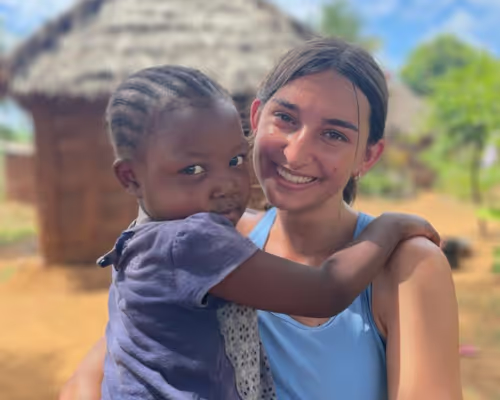
Open to under 18 students from schools across the UK, this adventure offers the perfect mix of fun, friendship, and impact. Work together as a team on vital marine conservation and community projects in the stunning coastal region of Kuruwitu. From regenerating coral reefs to building sustainable gardens, your efforts will help protect ecosystems and empower local communities.
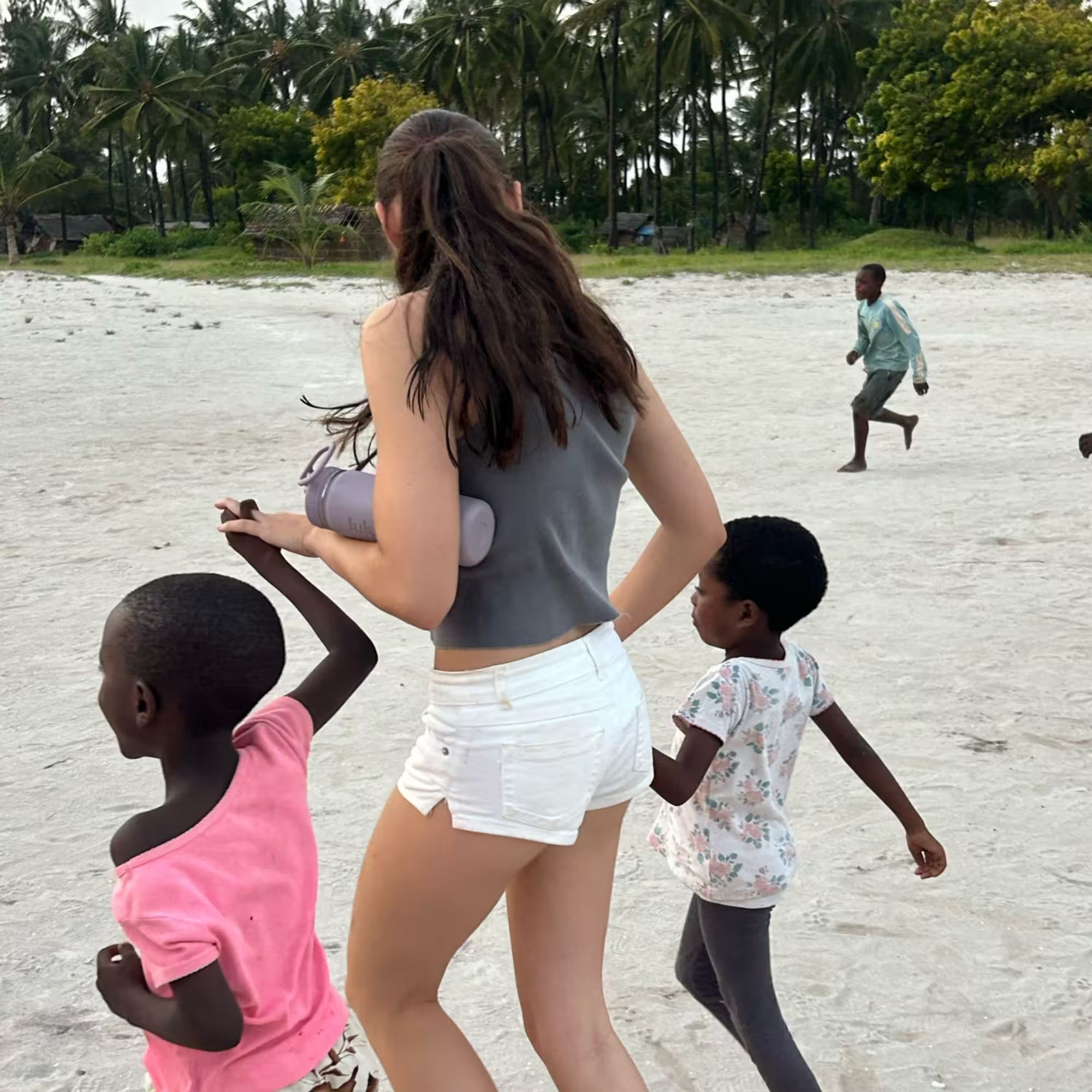
Whether your Leap was part of a gap year, an Under-18 summer or a school expedition, you came home with more than brilliant memories. You came home with real evidence for CVs, UCAS applications and interviews.
You already have the experience. Now you need to know how to use it.
Whether you’re writing your first CV, preparing for an interview or completing a UCAS application, these practical guides will help you identify your strongest Leap evidence and explain it with confidence.